The Illusion of the Workhorse
After forty years with my hands in the dirt, I’ve learned that callouses are often a poor substitute for a plan. In our modern culture, we’ve fallen into a seductive and dangerous trap: the belief that relentless effort is the only valid metric of success. We are taught that if a system is failing—be it a garden, a business, or a life—the only solution is to work harder, faster, and longer.
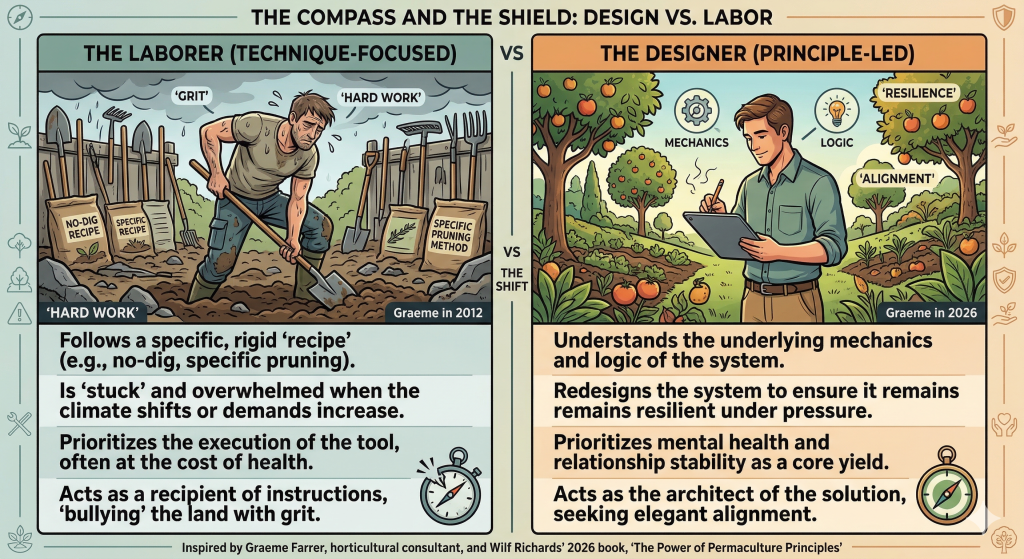
In 2012, I was the ultimate workhorse. My toolkit was heavy with every technique imaginable; I knew exactly how to prune a fruit tree to a tee and how to plant out a hundred-yard hedgerow. I was putting in twelve-hour days, fueled by the “Modern Trap” that says physical exhaustion equals productivity. But that year, I hit a wall. I was busy, but I was brittle. I was “wide open” to every demand because I lacked a way to filter the noise from the signal.By 2026, thanks to the lessons found in Wilf Richards’ design work, I’ve transitioned into an intentional designer. I no longer measure my worth by the depth of the holes I dig, but by the integrity of the systems I build.”Effort” does not equal “success.”
Technique vs. Principle: The Laborer’s Recipe vs. The Designer’s Logic
To escape the burnout of the workhorse, we must distinguish between a technique and a principle. A technique is a specific tool or a “recipe”—like no-dig gardening or a specific pruning cut. These are useful, but they are fragile. If the climate shifts, or if your personal life demands more than you can give, the recipe fails and the laborer is left stranded.Principles, however, are the mechanics of the system. They are the underlying logic that allows you to pivot.
As Wilf Richards emphasizes in his 2026 book, when you understand the principles, you become the architect. Crucially, if a technique fails the test of People Care —if it’s destroying your mental health or your relationships—the designer doesn’t just “work through the pain.” They recognize the system is broken and redesign it so it serves the person, rather than the person serving the tool.
The Metaphor of the Current: Pushing Water Uphill
The “Old Way” of living is characterized by a constant, grinding struggle against natural forces. It is the exhaustion of trying to push water uphill.
We do this because the “Modern Rules” tell us that if we aren’t struggling, we aren’t succeeding.A design-led approach seeks the Path of Least Resistance.
Instead of fighting the current, the designer identifies where energy is already moving and aligns their life with that flow.Intentional vs. Reactive Living:
Reactive: Fighting the flow, treating “effort” as a badge of honor, and trying to out-work systemic problems through sheer grit.
Intentional: Identifying existing energy currents, applying the principle of Working with Nature , and using design to reduce friction before the first shovel hits the ground.
Case Study in Friction: When Hard Work Failed
Before 2012, my professional life was a masterclass in friction. I remember a specific planting project where I thought I could bully the landscape into submission through sheer grit. The soil was wrong, the placement was fighting the wind, and the plants were struggling. My response? I worked harder. I hauled more water, I spent more hours pruning, and I doubled down on the techniques I had spent decades perfecting.
I failed. I attempted to out-work a systemic flaw. Because I hadn’t yet integrated the principle of Minimum Effort for Maximum Effect , I couldn’t see that my labor was a leak in the system, not a solution. I was digging holes for the sake of digging. A design-led approach would have shown me that the problem wasn’t a lack of effort—it was a lack of alignment with the site’s natural energy.
The Shield and the Filter: Ethics as a Framework for Refusal
In 2012, I was “wide open” to the world’s demands. I had no Shield to protect my time. That changed when I attended Wilf Richards’ design course. I learned that Permaculture Ethics—Earth Care, People Care, and Fair Shares—are not just abstract ideals; they are a functional filter. They provide the “Compass” that helps you navigate the modern trap and the “Shield” that allows you to say “no.”
The Triple Bottom Line
These three ethics act as the mechanic for refusal. If a commitment or a task cannot pass through these filters, it is a drain on your resilience and must be redesigned or rejected.
Earth Care: Does this activity regenerate the land and your personal energy, or does it leave you depleted?
People Care: Does this support your mental health and your family, or is it 2012-style burnout disguised as “work ethic”?
Fair Shares: Is there a clear limit to the energy you are pouring in, or is this a leak in your system with no equitable return?
The 3-2-1 Action Plan
Use this hierarchy to stop digging holes and start designing your way out of the trap this week.
3: The Ethical Filter
Run your three largest commitments this week through the Triple Bottom Line. Be confrontational with yourself:
Earth Care: Does this task regenerate your resources, or is it purely extractive?
People Care: Is this supporting your health, or are you sacrificing your well-being for a “recipe”?
Fair Shares: Are you getting a fair return for this energy, or is this a leak you need to plug? If a task fails any of these, it does not get your labor.
2: The Principle Application
Apply Minimum Effort for Maximum Effect to these two zones:
Zone 0 (Your Mind and Schedule):
Identify one area where you are “pushing water uphill” in your daily routine. Where can you stop fighting the flow?
Zone 1 (Your Immediate Home or Garden):
Move one physical element—a tool, a plant, a piece of furniture—to better align with how you actually move through your space.
1: The Immediate Yield
Identify and name one “Modern Rule” you follow that consistently drains your energy (e.g., “I must answer every email within ten minutes”). Do not break the rule yet. Simply naming it is your first yield; it is the raw data you need to design your escape.
Conclusion: Weaving the Web of Resilience
We are no longer just laborers digging holes; we are weaving a web of resilience. By using ethics as our filter and principles as our shield, we ensure the modern trap never catches us again. Abundance isn’t found in the struggle; it is found in the design.Are you ready to stop fighting the flow?
This reflection is an independent piece by Graeme Farrer, Horticultural Consultant and Permaculture Designer, inspired by the foundational wisdom found in Wilf Richards’ 2026 book, “The Power of Permaculture Principles“.