The Rebellion Against the Box
The industrial machine wants you specialized, sanitized, and predictable. It wants you in a precise professional box because boxes are easy to stack and even easier to replace. This is the “Modern Trap”—a world of straight lines, hard boundaries, and the soul-crushing sterility of corporate monoculture. If you look at a traditional farm map or a corporate org chart, you see this rigid, artificial order.But look at a natural ecosystem and you’ll find no such thing. Nature doesn’t do straight lines; it does “wobble.” It thrives in the messy, vibrant, and chaotic space where the woods meet the water. In permaculture, we call this the Edge. It is not a place of disorder to be feared; it is the most biologically active and productive place on Earth. To survive the coming decades, we have to stop pretending our lives can be filed away in neat, separate drawers. We must embrace the interwoven complexity of the Edge.
The Dead End of the Straight Line (Pre-2012)
I know the alternative because I lived it. Before I broke the seal on this post-burnout wisdom, my life was a textbook monoculture. I was told that focus meant exclusion—that to be a professional meant building high fences between my skills. By 2012, the lack of “edges” or “interfaces” in my work led me to a structural collapse.”
In 2012, I was stuck in the middle of a ‘monoculture’ lifestyle. I had no edges—just a long, straight road of overwork.
“This wasn’t just fatigue; it was the inevitable result of a system without a “wobble.”
When you strip away the natural overlaps of your interests to become a “specialist,” you become fragile. You become a crop waiting for a single pest to wipe you out.
Ecotone vs. Monoculture: The Resilience of the Transition Zone
In the wild, the Ecotone is the transition zone where two ecosystems meet—the fertile boundary where the forest’s shelter meets the lake’s resources. These zones are far more resilient than the deep interior of either system. Living at the Ecotone means bridging the gap between the ancient wisdom of the land and the jagged edge of new technology.
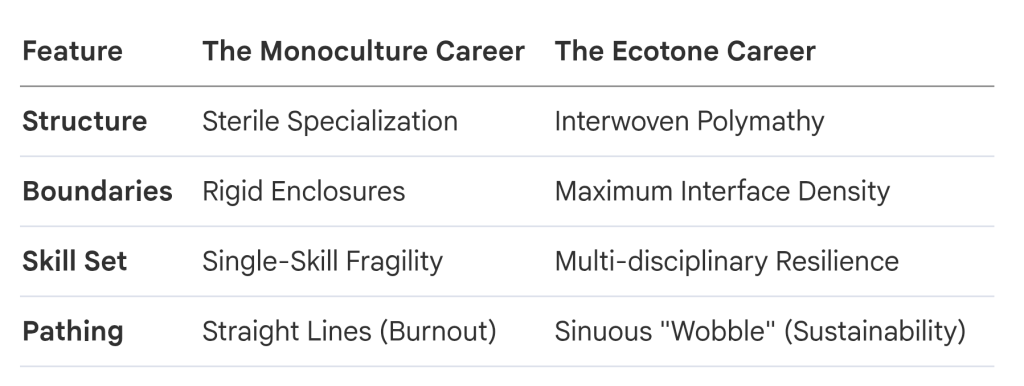
The most resilient people today are those who refuse to choose. They are the translators who can speak both “dirt” and “data.”
The Interwoven Service: Drones, Dirt, and Digital Infrastructure
We’ve been conditioned to view diverse skills as “distractions.” For years, I felt that repairing a computer or mastering drone flight was a detour from my “real” work in the soil. I was wrong. These aren’t distractions; they are the revolutionary tools of the Edge.
Drones and Big Patterns: Flying a drone is an act of deconstructing the Modern Trap. It provides an “eye in the sky” that reveals the Big Patterns of the land—patterns invisible to the ground-level specialist. This high-tech perspective allows for precise, less intrusive land-use decisions that protect the earth while maximizing yield.
Digital Infrastructure: A modern land steward without a digital ecosystem is as limited as a gardener without a shovel. Web design and social media aren’t “admin tasks”; they are the digital infrastructure required for a horticultural vision to survive and spread in the 21st century.
By interweaving these services, you create a value proposition that a “traditional” gardener simply cannot touch. You aren’t just planting trees; you are designing a resilient, visible, and technologically integrated future.
Maximizing the Margin: Design for Sinuosity
In a permaculture garden, we don’t design straight paths. We design “sinuous” edges. Why? Because a curved, wobbling line is longer than a straight one, providing more surface area—more interface—for life to take hold. You must apply this same design to your own career.
Increase your interface. Your tech-savviness shouldn’t be hidden; it should be used to enhance your consultancy. Your horticultural background should be the lens through which you pilot a drone. When you lean into these “marginal” skills, your income stabilizes because you are no longer a commodity. You are an ecosystem. The Edge is where creativity peaks and the “straight-line” exhaustion of 2012 finally dies.
The 3-2-1 Action Plan
Don’t wait for your own 2012 collapse. Use this framework to find your “wobble” and build resilience:
3: The Ethical Filter (The “Edge Check”)
Earth Care: Does interweaving your services (like using drones for site analysis) lead to more precise, less intrusive land-use decisions?
People Care: Does the variety of your work keep your mind engaged and prevent the personal burnout of a monoculture lifestyle?
Fair Shares: Are you using your “Edge” skills to provide a level of insight to your community that a single-skill provider could not achieve?
2: The Principle Application (Edge Effects)
Zone 0 (Business/Brand): Identify the “overlap” between your tech skills and your garden consulting. Identify one specific “Edge Service” you can offer this week. Spark: Consider offering precision mapping for food forests or automated irrigation logic based on site topography.
Zone 1 (Garden/Home): Identify a straight line in your landscape (a path or a fence). Describe how to make that edge more productive by adding a new element, such as vertical climbers or a border of herbs.
1: The Immediate Yield
Acknowledge one “Marginal” skill you’ve been ignoring because it didn’t seem to “fit” your main job. Recognizing it as a potential “Edge” for future growth is your first yield.
Abundance is at the Boundaries
Burn the boxes. The straight lines of the industrial past lead only to depletion and fragility. If your life doesn’t have a bit of “wobble,” you aren’t living; you’re just orbiting a drain.
We must stop fearing “messy overlaps” and start cultivating them. Abundance isn’t found in the sterile center of a specialty; it’s found at the boundaries where different worlds collide and collaborate. Embrace the mess. The edge is where the magic happens.
This reflection is an independent piece by Graeme Farrer, Horticultural Consultant and Permaculture Designer, inspired by the foundational wisdom found in Wilf Richards’ 2026 book, “The Power of Permaculture Principles“.