The 2012 Treadmill vs. The 2026 Path of Least Resistance
In 2012, my internal operating system was hard-wired for a single, destructive command: faster . When the bills piled up, I didn’t look for a more efficient system; I simply threw more exhausted hours at the problem. When my relationships frayed under the tension of my absence, I attempted “
Big and Fast” repairs—high-pressure, expensive weekends designed to bridge gaps that required daily presence. I was sprinting on a treadmill fueled by fossil-fuel-level urgency, oblivious to the fact that I was running toward a cliff.”
I thought that ‘Big and Fast’ was the only way to succeed, but all I was doing was burning through my own engine.
By 2026, I had traded the treadmill for the Path of Least Resistance. This isn’t about laziness; it’s about a fundamental shift from the “Big and Fast” fallacy to the “Small and Slow” methodology. It is the realization that a system designed for maximum speed is a system designed for maximum failure. Today, I prioritize energy cycling over energy consumption, moving away from the “sprint” and toward a lifestyle that mimics the resilience of a climax ecosystem.
Deconstructing the “Modern Trap”
The “Modern Trap” is a systemic lie that rewards high-speed exertion while ignoring the state of the “personal battery.” In our rush to achieve “overnight success,” we incur a massive amount of “re-work”—the hidden ecological debt of doing things twice because we were too hurried to do them right the first time.
In permaculture, we recognize that speed is often the enemy of observation. When we move too fast, we miss the subtle feedback loops that tell us our systems are leaking energy. By slowing down, we stop the “re-work” cycle and allow our personal reserves to recharge.
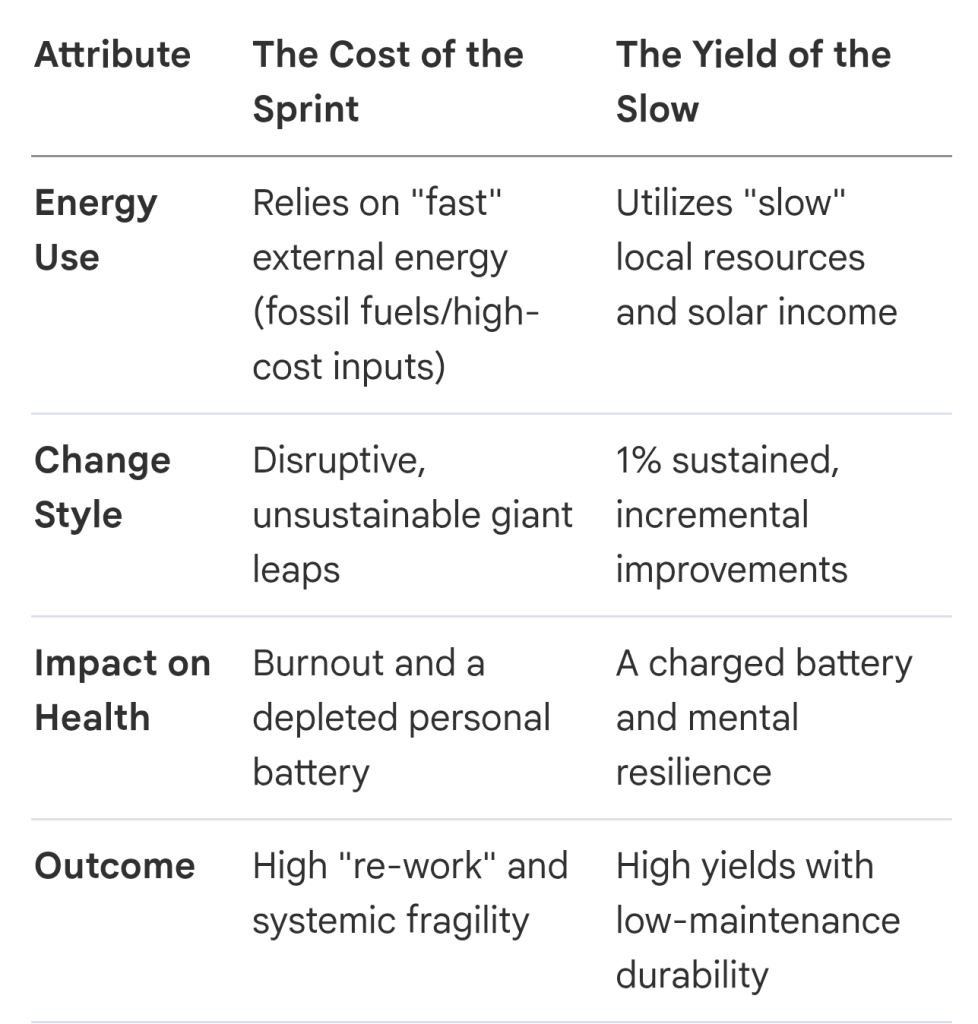
The following table outlines the transition from a high-impact, low-yield sprint to a low-impact, high-yield slow design.
The Cost of the Sprint vs. The Yield of the Slow
Mastering “Relative Location” in Digital and Physical Life
In his book, The Power of Permaculture Principles , Wilf Richards emphasizes that true efficiency is found in Relative Location . This principle dictates that the success of any element depends on its proximity to the things it interacts with. In a garden, if your compost bin is a fifty-yard trek from the kitchen, you will eventually stop composting. If your tool shed requires a ten-minute walk from your garden beds, you are leaking hours of productive energy into the “travel” between tasks.
Translating this to lifestyle design requires us to analyze our “Zones”:
Zone 0 (Your Workflow): This is your immediate digital or professional environment. In my work with drone aerial imagery and web design, I stopped chasing the “newest and fastest” fleet. I mastered one drone. I didn’t manage fifty social media accounts; I built a single, high-efficiency system. I placed my “digital tools” exactly where my “mental travel” was shortes
Zone 1 (Your Home/Garden): This involves placing the most frequently used physical elements—from your morning coffee station to your PC repair tools—directly along your natural path of travel. By eliminating these micro-leaks, we stop “burning through the engine” just to get to the starting line.
Metaphor: Planting a Forest vs. Running a Race
The modern world views life as a race. But a race is a linear drain on resources; once you cross the finish line (or collapse), your reserves are spent, and you are left exactly where you started: needing more external input to go again.Conversely, the “Small and Slow” approach is like planting a forest . A forest doesn’t sprint. It observes and interacts. It starts with small seeds and incremental designs that stack functions—where one element’s waste becomes another’s fuel. Because it grows slowly, it has time to develop deep roots and resilient structures that catch and store energy.
By applying the principle of “Observe and Interact,” we ensure that every small change is fully integrated and efficient before we add the next layer. This prevents the “re-work” of the race and creates an abundance that is self-sustaining. A forest doesn’t need a treadmill; it creates its own momentum.
The 3-2-1 Action Plan
To move from a state of depletion to a state of yield, apply this structured filter to your coming week:
3: The Ethical Filter (The “Pace Check”)
Earth Care: Does this project rely on “fast” external energy or high-cost inputs? Can you pivot to a “slow” local resource?
People Care: Is your current work speed sustainable for your nervous system, or is it a 2012-style sprint in disguise?
Fair Shares: Are you moving slowly enough to notice if you are taking more than your “fair share” of energy from your future self?
2: The Principle Application (Small & Slow Efficiency)
Zone 0 (Digital Workflow): Identify one repetitive manual task in your web design or PC repair process. Move a “digital tool” closer by pinning a critical app to your taskbar, setting up a keyboard macro, or creating an automated email filter to save five minutes of “mental travel” daily.
Zone 1 (Physical Space): Identify the tool or item you use most often that is currently located “too far away.” Move it directly into your path of travel this week to eliminate a physical energy leak.
1: The Immediate Yield
Identify one “Small Solution” that has already yielded a significant impact on your life. Whether it is a daily habit or a simple tool placement, recognize that the energy you saved is your true profit.
Abundance at its Own Pace
Slowing down is the ultimate power move because it allows us to stop chasing overnight fixes and start building 1% improvements that can be sustained for a decade. We are no longer sprinting to stay in place; we are planting seeds for a forest that will provide for us long after the race has ended.
Are you ready to slow down and move faster?
This reflection is an independent piece by Graeme Farrer, Horticultural Consultant and Permaculture Designer, inspired by the foundational wisdom found in Wilf Richards’ 2026 book, “The Power of Permaculture Principles“.