Categories
Design for Life

The Day the Shovel Broke: Why My Professional Expertise Couldn’t Save My Personal Life

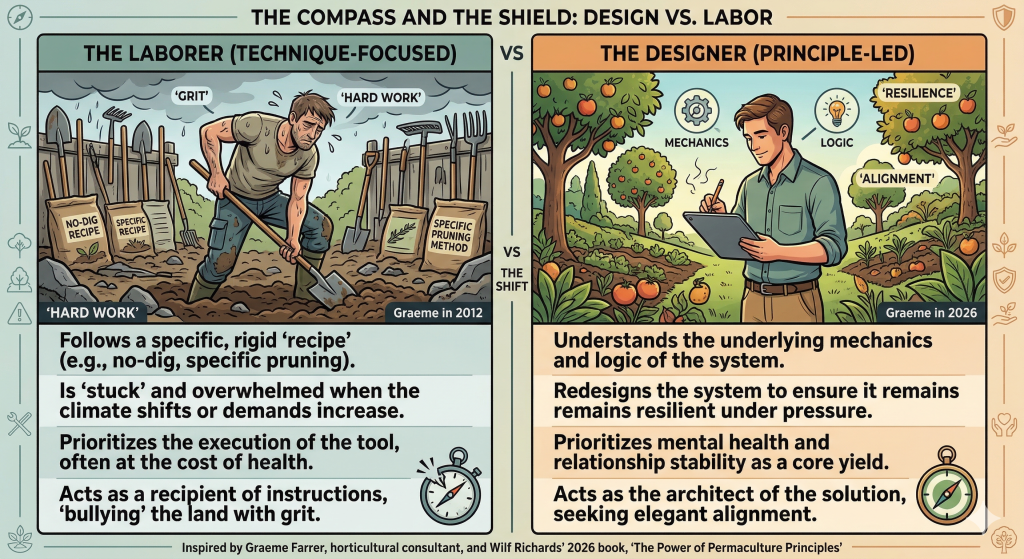
I’ve spent forty years with my hands in the dirt. My palms are a map of callouses and old scars, earned from four decades of building landscapes intended to outlast the people who commissioned them. Professionally, I was a master of my craft; I knew the nitrogen requirements of a brassica bed and the structural integrity of a dry-stone wall like the back of my hand. But by 2012, I had to face a gut-wrenching irony: I was a horticultural expert who had failed to build a personal life that could sustain a human heart.

While I was out in the field designing “lifelong landscapes,” I was blind to the “clear-felling” happening in my own home. I could smell the rot in the roots of a sapling from twenty yards away, but I couldn’t see the dieback in my own living room. That year, I hit a wall of burnout so thick it didn’t just slow me down—it shattered the foundations.

My partner and I were both caught in the same exhausting, reactive cycle, buckling under the weight of a lifestyle that demanded more than we had to give. Eventually, the system snapped. The relationship collapsed. I was left standing in the wreckage of a life that had run out of “pore space.”

This was my  Hinge Point , the moment I realized that forty years of expertise meant nothing if I couldn’t design for my own resilience.

The “Modern Trap” Operating System

In 2012, I was a victim of “soil mining.” In the gardening world, this is the process of extracting every nutrient from the earth without ever putting organic matter back. I was treating myself as an infinite resource, running on a corrupted internal software I call the “Modern Trap.” Its logic is simple and deadly:  More is better, faster is better, and the gardener can always pull another shift.

The physical sensation was exactly like an overworked, over-trafficked soil bed. I was depleted and severely compacted. When soil is compacted, it loses its structure; there is no room for air or water to move. In my life, this meant that even when “nutrients” or moments of joy were available, they couldn’t penetrate the surface. My schedule was so tight and my mind so hardened by stress that everything good just became “runoff”—sliding off the surface because I had no capacity to absorb it. I was trying to grow a future in ground that had been exploited until it turned to dust.

Techniques vs. Principles: The Software Update

When I finally turned to Wilf Richards’ Permaculture Design Course to rebuild, I realized I had been obsessed with “Techniques” while ignoring “Principles.” In his work, Wilf points us back to the  Principium —the beginning, the foundation.

  • Technique (The Tool):  This is the “what.” It’s double-digging a bed or installing a swale. It’s a specific action for a specific result.
  • Principle (The Software):  This is the “how to think.” It’s the foundation-level logic, like “Working with Nature.”

I had all the tools, but my software was broken. You can have the best shovel in the world, but if your logic tells you to dig a hole in a dry creek bed during a flood, the tool won’t save you. I had to delete the “Modern Trap” and install a new way of processing reality based on the  Principium .

The Three-Sided Life: Beyond the Practical

A resilient design is never a straight line; it’s a triangle. Wilf’s book taught me that for any system to survive, it must be three-sided. In 2012, my life was a one-legged stool, propped up entirely by the  Practical .

  1. Scientific (The Mechanics):  Understanding the hard data and the physical limits of the system.
  2. Practical (The Work):  The labor, the “doing,” and the daily grind.
  3. Spiritual (The Connection):  The deeper purpose, the “why,” and the emotional resonance.

I had mastered the Practical, but I was scientifically illiterate regarding my own energy limits and spiritually bankrupt regarding my purpose. Integrating all three redefined my “Job Description.” I stopped being a mere manager of plants and started being a designer of a three-sided human life.

The Ethical Bedrock: People Care as Design

Permaculture isn’t just a set of gardening rules; it’s an ethical framework. My 2012 collapse happened because I treated these ethics as optional “nice-to-haves” rather than design requirements.

  • Earth Care
  • People Care
  • Fair Shares

The most painful lesson I learned was that “People Care” starts with the person in the mirror. It is a mandatory requirement because  if the gardener breaks, the garden dies.  My relationship failed because of an “inability to say enough”—a failure of the “Fair Shares” ethic. We were distributing our energy to everyone and everything else, leaving nothing for the core of the system. I had to transition from “managing plants” (controlling variables) to “designing a life” (nurturing the entire system).

Patterns over Details: The Professional Secret

After 40 years, here is the professional secret: We use “Details” to hide from the truth.”We obsess over details—the next bill, the next task, the immediate crisis—specifically to avoid looking at the Pattern. The pattern is a lifestyle that requires more emotional energy than it returns.”True design doesn’t start with which seeds to plant; it starts by stepping back until the overarching pattern of the landscape becomes clear.

The 3-2-1 Action Plan: Week 1

If you are currently standing where I was in 2012—buckling, reactive, and nearing the snap—here is your audit for the first week.

3: The Ethical Audit

Pass your current life design through the three ethics. Be ruthless. If your current pace or lifestyle fails the “People Care” test,  it isn’t a design—it’s a drain.  If it’s a drain, it must be plugged or redirected. Identify one commitment this week that you will drop to prioritize your own resilience.

2: Zonal Observations
  • Zone 0 (Mindset):  Identify one “modern rule” you live by (e.g., “I must answer every email immediately”) that is contributing to your compaction.
  • Zone 1 (The Threshold):  Sit at your back door for 10 minutes. Do nothing. No phone, no shovel. Simply observe a natural world that functions perfectly without your constant, frantic management.
1: The Immediate Yield

Identify and write down your “Chaos Point”—the specific part of your life that feels most out of control. Label it. Don’t try to fix it yet. Over the next  24 weeks , we are going to use that chaos as the “mulch” to feed your new, resilient life.

Conclusion: Abundance is a Choice

Looking back from the perspective of 2026, I am no longer a wreck. I am a gardener who finally understands that the most important thing I ever grew was a boundary. Abundance isn’t a harvest of more “stuff”; it’s the result of a system that is balanced enough to sustain itself.

The transition from a reactive life to a resilient one is possible the moment you stop digging and start designing.

This reflection is an independent piece by Graeme Farrer, Horticultural Consultant and Permaculture Designer, inspired by the foundational wisdom found in Wilf Richards’ 2026 book, “The Power of Permaculture Principles“.

Categories
Welcome to Permaculture Solutions (UK)

Permaculture Solutions: Design for Life.

I am thrilled to announce the launch of my new podcast and explainer video series: Permaculture Solutions: Design for Life.

After 40 years as a Professional Gardener, and more recently as a Horticultural Consultant and Permaculture Practitioner, I’ve learned that our greatest challenges—from climate shifts to rising costs—are actually opportunities for better design…..and the greatest tools available aren’t physical, they are principles.

Starting this March, I’m heading back to the classroom, whilst simultaneously taking others on a deep dive into principles of Permaculture.

Following weekly sessions with renowned author Wilf Richards, I’ll be breaking down the principles and discussing this and other aspects of his new book “The Power of Permaculture Principles”, via a weekly podcast on Spotify and explainer video on YouTube.

We’ll explore how to apply these ethical, nature-based solutions to your land, your home, and your community.

So whether you’re just starting out, ready to move beyond “traditional” gardening and start building a truly regenerative life, looking to refresh or deepen your knowledge, maybe discover more solutions, then this show is for you.

👇 The official trailers are LIVE right now!

First session due out on march 13th.

Hit the players below to listen and watch now and don’t forget to like and follow the show, so you don’t miss the first session due out on march 13th.

Enjoy the masterclass. Lets build the solution together!

#PermacultureSolutions #DesignForLife #RegenerativeDesign #GraemeFarrer #PermaculturePrinciples #SustainableLiving #AbundantEarth #ResilientGardens

Categories
Welcome to Permaculture Solutions (UK)

Conscious Relationships

Redefining Love with Permaculture Principles

We are entering a period where relationships are ripe for transformation. The current paradigm is failing; people are increasingly unsatisfied in love, struggling to make relationships work. Surprisingly, this isn’t necessarily a negative development. When systems break down, they are forced to change, and this is exactly what’s happening in the realm of intimate partnerships. The breakdown is propelling us towards conscious love.

What Is a Conscious Relationship?

A conscious relationship is one where both partners are committed to a shared purpose: growth. This growth is both individual and collective, and it extends beyond the couple, aiming to contribute positively to the world.

Traditionally, people enter relationships to satisfy personal needs. While this might work for a time, eventually, the relationship falters, leaving both parties unsatisfied. However, when two people come together with the intention of growth, the relationship evolves into something far greater than mere gratification. The partnership becomes a journey of mutual evolution, allowing both individuals to expand in ways they couldn’t alone, resulting in deep satisfaction and long-term fulfillment.

If you feel called to elevate your experience of romantic love, consider these four qualities that define a conscious couple. This is next-level love.


1. Growth Comes First: Not Attached to the Outcome

Not being attached to the outcome doesn’t mean you don’t care about the future of the relationship or that you don’t have dreams for it. Rather, it means that you’re more committed to the experience of growth than to making the relationship “work” at all costs.

We’re here to grow—physically, mentally, emotionally, and spiritually. When growth ceases, something vital is lost. Unfortunately, many relationships today stifle growth rather than enhance it. This is a primary reason why romantic love often fails.

In the effort to please our partners, we repress our true selves, eventually feeling small and disconnected from who we are. This makes the relationship feel like a cage, one that we unknowingly construct ourselves. However, the conscious couple prioritizes growth because they understand it’s the key to keeping the relationship alive. While growth can be frightening—leading us into unknown territories—the conscious couple embraces this, even at the risk of outgrowing the relationship. This commitment to growth keeps the relationship and the love between the partners vibrant and alive.

Permaculture Insight: Just as permaculture seeks to create systems that are self-sustaining and regenerative, conscious relationships thrive on the continuous growth of both individuals. By applying permaculture principles—such as observing and interacting, catching and storing energy, and using small, slow solutions—couples can cultivate a relationship that grows and evolves in a sustainable, life-affirming way.


2. Owning Your Baggage: Personal Responsibility

Conscious couples understand that everyone carries wounds from the past, and they recognize that these wounds will inevitably be triggered in a relationship. They expect to feel emotions like abandonment, rejection, or entrapment when they bond closely with another person.

Many people believe that relationships should only feel good, and when negative emotions arise, they think something is wrong. However, these feelings often stem from our own unresolved issues, not from our partners. The conscious couple is willing to confront these beliefs because they know that facing and healing these patterns allows them to evolve into a new, healthier relationship dynamic. Dysfunctional patterns dissolve only when we first take responsibility for them.

Permaculture Insight: Permaculture emphasizes turning problems into solutions—an idea that can be translated into relationships. By addressing and transforming personal challenges, couples create fertile ground for a relationship that supports growth and healing.


3. All Feelings Are Welcome: Radical Honesty

In a conscious relationship, there’s room to feel and express anything. This is challenging territory, but it’s also one of the most healing experiences a partnership can offer.

Radical honesty—revealing the hard-to-share parts of ourselves and allowing our partners to do the same—leads to feeling truly known and understood. This authenticity enhances the love in the relationship. Just as permaculture emphasizes the importance of diversity and integration in ecosystems, conscious relationships thrive when all emotions and experiences are welcomed and integrated into the relationship’s dynamic.


4. Love as a Practice: Continuous Cultivation

Ultimately, love is a practice—one of acceptance, presence, forgiveness, and vulnerability. Love isn’t a destination; it’s a journey of exploration. The conscious couple is committed to embodying love, continually asking, “What would love do here?” This practice fosters growth and deepens the connection in ways that neither partner could have imagined.

Permaculture Insight: Permaculture teaches us that the health of an ecosystem depends on the continuous nurturing of its components. Similarly, in a conscious relationship, love must be continuously practiced and cultivated, leading to a relationship that is resilient, sustainable, and ever-growing.


By incorporating the principles of permaculture design into your relationship, you can further develop a conscious partnership that not only nurtures the individuals involved but also contributes to the broader ecosystem of your life and community. This is the path to a thriving, sustainable, and deeply fulfilling love.