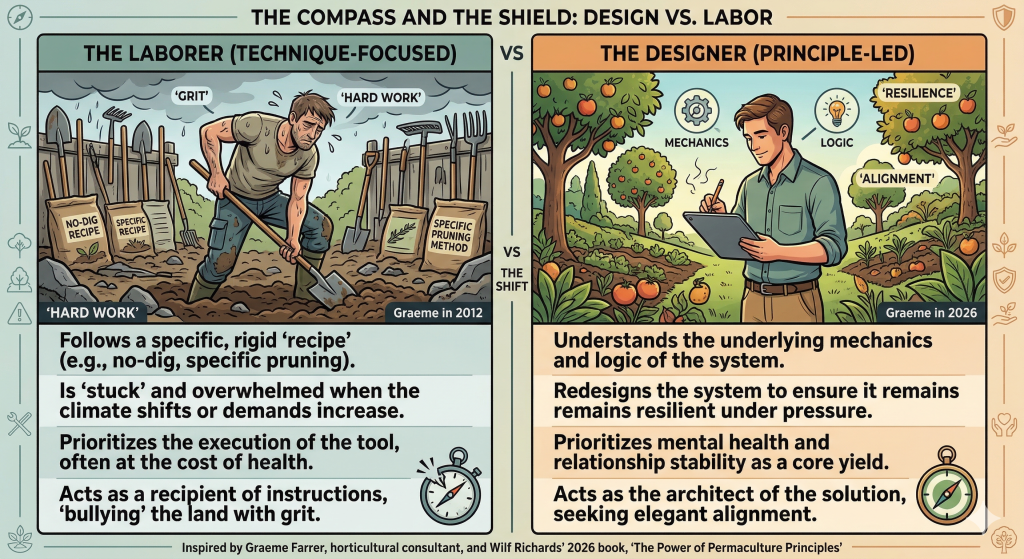
The View from the Ground vs. The View from the Clouds
After forty years of professional horticulture, my knees remember the soil more than my eyes sometimes remember the sky. This is the reality of “Hand-and-Knee Gardening”—a state of being where you are nose-to-nose with the details, squinting at the earth. It is a claustrophobic space where you might obsess over the precise pruning of a box hedge or the perfect placement of a single perennial while a storm cloud gathers unnoticed on the horizon. We focus so hard on the microscopic that we miss the fact that the entire landscape is gasping for air.
True ease is found not in the soil, but in the “Vantage Point.” To find it, we must practice “Vantage Point Designing.” This requires us to “zoom out” and witness the “Big Bones” of the system before we ever reach for a trowel or a calendar. My own vision was often clouded by the very soil I was tending, but I invite you now to stand up, stretch your back, and breathe. When we stop squinting at the tasks and start observing the broader landscape, we realize that when the overarching pattern is healthy, the details begin to harmonize on their own.
Redefining the “Wreckage”: From Bad Days to Bad Patterns
In 2012, I hit what I now call “The Wreckage.” At the time, I viewed it as a string of isolated misfortunes—a series of bad days marked by arguments, the dull ache of tired muscles, and the relentless, invasive buzzing of messages on my phone. I thought I just needed to work harder, to “tweak” the details of my schedule.
I was looking at the weeds when I should have been looking at the map.The “Modern Trap” is not a bad day; it is a “Pattern of Exhaustion.”
It is a lifestyle designed in such a way that it requires more energy, time, and spirit than it can ever possibly return to you. You cannot fix a systemic deficit by managing your chaos more efficiently. You cannot “to-do list” your way out of a foundational design flaw. Transitioning from the wreckage of 2012 to the abundance I live in today, in 2026, required more than effort—it required a complete redesign of the map. I had to stop managing symptoms and start designing flow.
The “Zoom Out” Method: Designing with the Big Bones
In his transformative work, Wilf Richards teaches us to “zoom out” before we ever pick up a tool. Most people succumb to “Detail-First thinking”: they see a beautiful plant at a garden center and then spend years struggling to keep it alive in the wrong soil. Permaculture flips this, prioritizing “Pattern-First thinking.”
To design a life that supports you, you must observe three primary patterns before making a single move:
The Pattern of Water: In the garden, we ask where it pools and where it flows. In life, we must look at the flow of our “liquidity”—not just money, but the emotional energy that sustains us. Where is it stagnant? Where is it draining away?
The Pattern of Energy: We track the sun cycles, noting where the light hits in the depths of February versus the height of August. Similarly, we must track the rhythm of our own vitality. When are you “in the sun,” and when does your internal winter require rest?
The Pattern of History: We seek to understand the land’s legacy—what existed there before us. In our personal lives, we must acknowledge the inherited patterns and stories that shaped our current landscape.When you design around these “Big Bones,” the details—the specific plants, the daily habits, the career paths—almost choose themselves. You cease to be a manager of chaos and become a designer of flow.
Working with the Grain: The Power of the Sail
Nature is the ultimate strategist. It does not move at random; it uses specific patterns for maximum efficiency, like the branching of a tree to move nutrients or the golden spiral of seeds in a sunflower. When we align our lives with these natural laws, we are “working with the grain” of the universe.
It is the difference between rowing a heavy boat against a relentless tide and finally, mercifully, setting a sail. By adopting natural patterns, we ensure our work is supported by the weight of the universe rather than being fueled solely by our own diminishing force of will. To set your own sail, we must first look at the rigging of your daily life.
The 3-2-1 Action Plan
To move from the exhaustion of the ground-view to the clarity of the clouds, apply this structured reflection to your world this week.
3: The Ethical Filter (The “Master Pattern”)
Examine the “Overall Flow” of your week through the triple-filter of permaculture ethics. If a pattern fails these, it is not sustainable:
Earth Care: Does your current lifestyle pattern deplete or nourish your local environment?
People Care: Is the pattern of your work-life balance sustainable for your heart and health?
Fair Shares: Is there enough “space” in your pattern to return surplus time and energy to yourself and your community?
2: The Principle Application (Patterns to Details)
Identify one natural pattern—such as an Edge (where two different systems meet) or Flow (the path of least resistance)—and apply it to these two zones:
Zone 0 (The Mind): Identify a repetitive “Mental Pattern” you experience every Monday. Is this pattern serving your growth, or is it a detail you are needlessly obsessed with?
Zone 1 (The Home): Observe a “messy corner” in your house. Instead of simply cleaning it (a detail), redesign the movement of the space. What pattern of behavior causes the mess, and how can the flow be redirected?
1: The Immediate Yield
Take 15 minutes to look at your garden or a room from a high vantage point—climb a ladder or look out from an upper-floor window. Identify one large-scale pattern (a shadow, a slope, or a path of travel) that you previously missed because you were too busy looking at the ground. This shift in perspective is your yield. The moment you see the pattern, the solution becomes obvious.
Conclusion: Abundance is in the Map
We are finally shifting our focus from looking at the weeds to looking at the waves. By moving from Patterns to Details, we ensure that our lives are no longer a struggle against the current, but a journey supported by the natural laws of the world. Abundance is rarely found in the completion of chores; it is found in the wisdom of the map we draw for ourselves.Are you ready to zoom out and see the real map?
This series is an independent reflection by Graeme Farrer, Horticultural Consultant and Permaculture Designer, inspired by Wilf Richards’ 2026 book, “The Power of Permaculture Principles”.